Brand Positioning — Định vị thương hiệu trong tâm trí khách
Brand Positioning là 'chỗ đứng' thương hiệu trong tâm trí khách so với competitor — định vị theo Al Ries + Jack Trout (1981). Bài này dạy 5 strategy positioning (cost leader, differentiation, niche, blue ocean, jobs-based), template positioning statement, ví dụ thực tế VN.
Mục lục bài viết(24)
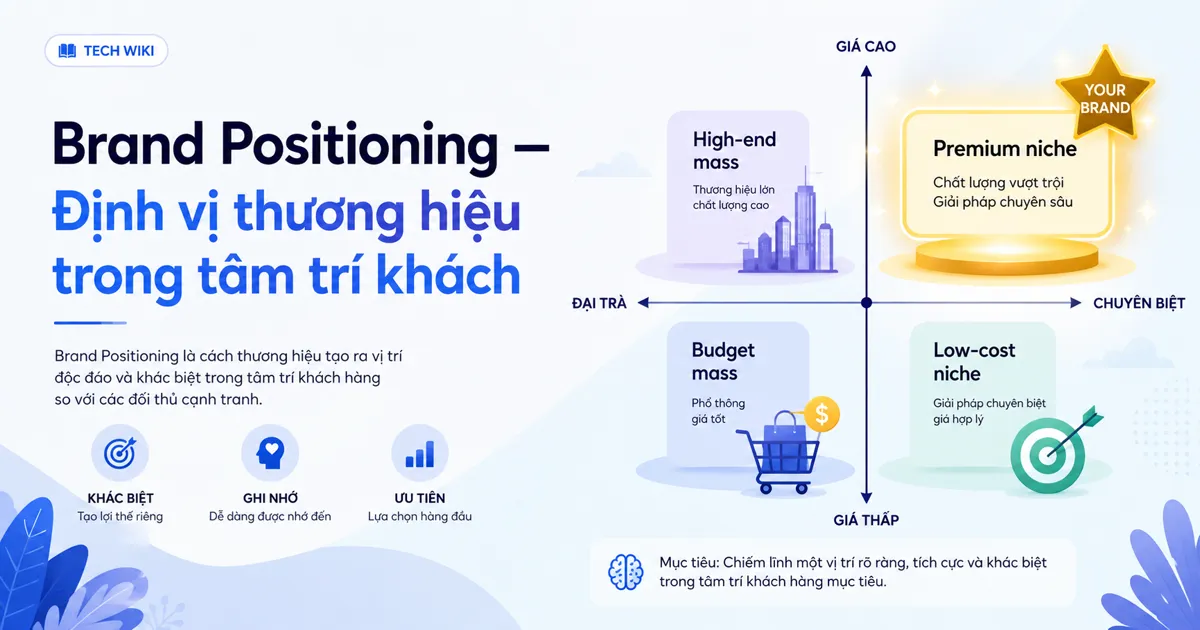
Brand Positioning = chỗ đứng độc nhất trong tâm trí khách so với competitor. Al Ries + Jack Trout 1981. Perceptual Map 2x2 identify gap. 5 strategy: cost leader, differentiation, niche, blue ocean, jobs-based. Ảnh: AI-generated bằng ChatGPT gpt-image-2.
Hiểu đơn giản nhất
Bạn vào quán cafe ở Hà Nội. Có 100 quán xung quanh. Khi nghĩ "trưa nay uống cafe ở đâu", trong đầu bạn pop-up:
- Highlands → "rẻ + tiện + có wifi"
- Phúc Long → "trà chuẩn vị + ngon hơn cafe"
- The Coffee House → "ấm cúng + gặp bạn"
- Cộng Cafe → "truyền thống VN + không gian retro"
- Starbucks → "Mỹ + cao cấp + brand toàn cầu"
Mỗi quán own 1 concept trong đầu bạn. Đó là Brand Positioning.
Nếu mở quán mới = "cafe ngon + tiện + ấm cúng + retro" → cố cạnh tranh mọi mặt = positioning fuzzy → khách không nhớ.
Strategy đúng: chọn 1 góc chưa ai chiếm + dồn 100% effort. Vd: "cafe specialty single-origin VN + workshop hàng tuần" → own niche specialty coffee.
Brand Positioning — Định nghĩa + lịch sử
Brand Positioning = mental position thương hiệu chiếm trong tâm trí target customer, so sánh tương đối với competitor. Không phải "thương hiệu nói gì" mà là "khách nghĩ gì khi nghe tên".
Lịch sử
- 1981 — Al Ries + Jack Trout xuất bản "Positioning: The Battle for Your Mind". Coin term "positioning" như chiến lược marketing độc lập.
- 1991 — Geoffrey Moore "Crossing the Chasm" thêm positioning statement template cho tech startup.
- 2003 — W. Chan Kim + Renée Mauborgne "Blue Ocean Strategy" — positioning bằng cách tạo new category.
- 2010s — Inbound marketing + content marketing make positioning visible qua content choice + topic cluster.
- 2026 — AI Overview + personalization shift positioning từ "1 vị trí cố định" sang "context-aware positioning" (vị trí khác cho query khác).
Quote nổi tiếng Al Ries
"Positioning is not what you do to a product. Positioning is what you do to the mind of the prospect."
Tạm dịch: "Positioning không phải bạn làm gì với sản phẩm, mà bạn làm gì với tâm trí khách hàng tiềm năng."
5 Positioning Strategy phổ biến 2026
Strategy 1: Cost Leader (Người dẫn đầu giá)
Định vị: Rẻ nhất trong category.
Khi dùng:
- Market commodity, ít differentiation
- Bạn có economies of scale (volume lớn → cost thấp)
- Customer price-sensitive (B2C mass)
Risk:
- Race to bottom — competitor giảm giá hơn
- Brand perception cheap → khó upsell premium tier
Vd VN:
- Vinamilk (cost leader sữa VN)
- Saigon Co.op (supermarket rẻ)
- VietJet (low-cost airline)
Strategy 2: Differentiation (Khác biệt hoá)
Định vị: Sản phẩm unique trên feature/quality/experience.
Khi dùng:
- Có innovation thật, defensible
- Customer willing pay premium cho value
- Brand resources đầu tư R&D + marketing
Risk:
- Competitor copy nhanh → moat shrink
- Innovation cost cao
Vd VN/global:
- Apple iPhone (design + ecosystem)
- VinFast (EV VN-made)
- Tiki Now (2h delivery)
Strategy 3: Niche Focus (Tập trung ngách)
Định vị: Best trong 1 segment hẹp.
Khi dùng:
- Startup không có resource compete mass
- Segment ngách growing nhanh
- Founder có expertise/network niche đó
Risk:
- Niche stagnant → growth ceiling
- Competitor mass enter ngách → squeeze
Vd:
- Tesla 2008-2015 (EV luxury sport) — niche trước expand mass
- BTB (Backlink Entity service for B2B VN)
- Stripe đầu (developer-friendly payment API)
Strategy 4: Blue Ocean (Tạo market mới)
W. Chan Kim + Renée Mauborgne 2005. Định vị: tạo category chưa tồn tại thay vì compete trong category đỏ máu.
Workflow Eliminate-Reduce-Raise-Create:
- Eliminate factors industry assume mandatory
- Reduce factors industry over-deliver
- Raise factors industry under-deliver
- Create factors industry chưa nghĩ tới
Vd kinh điển:
- Cirque du Soleil = circus + theater (eliminate animals, raise art, create artistic experience)
- Nintendo Wii = casual gaming (eliminate hardcore graphics, create motion control)
- VinFast EV VN = create domestic EV manufacturer (raise national pride angle)
Strategy 5: Jobs-Based (JTBD Positioning)
Tony Ulwick + Clayton Christensen extension. Định vị: own 1 job khách "hire" sản phẩm.
Workflow:
- Identify job khách hire competitor (xem Customer Persona + JTBD)
- Identify gap competitor chưa serve job đó tốt
- Position bạn = "best at this specific job"
Vd:
- Slack = team async chat (job: communicate without meeting)
- Notion = all-in-one workspace (job: replace 5 tools)
- VietCodex = AI dev agency for non-tech founder (job: ship MVP 2-4 tuần dưới $5k)
Perceptual Map — Tool visualize positioning
Perceptual Map = matrix 2 trục plot competitor + bạn theo 2 attribute customer care nhất.
Cách build Perceptual Map
Bước 1: Identify 2 attribute quan trọng cho customer.
- Vd cho coffee shop: Giá (rẻ-đắt) + Trải nghiệm (basic-premium)
- Vd cho SaaS: Price ($-$$$$) + Feature depth (basic-advanced)
Bước 2: List 5-10 competitor + bạn.
Bước 3: Score mỗi brand trên 2 attribute (1-10).
Bước 4: Plot lên scatter plot 2x2.
Bước 5: Identify gap = vùng không có brand → opportunity.
Vd Perceptual Map cho VietCodex
Trục X: Giá ($1k-100k/project). Trục Y: Tốc độ (1 tuần - 12 tháng).
       TỐC ĐỘ 1 TUẦN
              |
              |
       v0.dev | VietCodex
       (free) | (mid-price)
              |
              |
GIÁ THẤP -----+----- GIÁ CAO
              |
              |
       Truyền | High-end
       thống  | agency
       agency | (premium)
              |
              |
       TỐC ĐỘ 12 THÁNG
VietCodex sweet spot: Mid-price + Fast — khoảng trống competitor. Truyền thống agency chậm + đắt. v0.dev free + nhanh nhưng quality thấp.
Positioning Statement Template
Geoffrey Moore template (Crossing the Chasm):
For [target customer]
who [statement of need / opportunity],
[our brand] is the [category]
that [unique benefit / key value proposition].
Unlike [primary competitive alternative],
our brand [statement of primary differentiation].
Vd VietCodex positioning statement:
For non-tech founder VN
who want to ship MVP in 4 weeks to validate startup idea,
VietCodex is the AI-native dev agency
that delivers production-grade SaaS in 4-12 weeks at $5k-50k.
Unlike traditional dev agencies which take 3-6 months and cost $20k-100k,
our brand uses AI Coding (Claude Code + Cursor + multi-agent routing)
to deliver 3-5x faster at 1/3 cost.
Vd BTB positioning statement:
For Marketing Manager B2B SaaS VN
who need to build DR from 0 to 30 in 12 months,
Backlink Thái Bình is the SEO + Backlink agency
that provides white-hat Backlink Entity service for B2B VN niches.
Unlike PBN networks and bulk link sellers,
our brand has 8-year track record, 200+ client, ZERO manual action from Google.
4 sai lầm Positioning phổ biến
Sai lầm 1: Positioning theo feature thay vì benefit
❌ "VietCodex dùng Claude Code + multi-agent + TDD" (feature) ✅ "VietCodex ships MVP 4 tuần thay vì 6 tháng" (benefit)
Customer không quan tâm tech bạn dùng — quan tâm outcome họ nhận.
Sai lầm 2: Position "best at everything"
"Chúng tôi rẻ + nhanh + chất lượng cao + service tốt" → khách không tin (impossible all 4) + positioning fuzzy.
✅ Pick 2 attribute top. Acknowledge weakness ở attribute khác.
Sai lầm 3: Positioning theo what bạn làm, không theo who là khách
❌ "Chúng tôi là dev agency" (generic) ✅ "Chúng tôi là dev agency cho non-tech founder VN ship MVP 4 tuần" (specific WHO + WHEN)
Sai lầm 4: Skip competitor benchmark
Position trong vacuum → tưởng unique nhưng competitor đã claim.
✅ Audit top 10 competitor positioning trước khi finalize. Tool: Brand SERP search, AdLib (FB Ads Library), competitor LinkedIn.
Re-positioning — Khi nào + cách
Re-position SLOW + careful. 3 trigger valid:
- Market shift fundamental — vd AI Overview 2024 → SEO agency phải re-position từ "rank top" → "AI cite-target"
- New leadership + new vision — vd Apple 1997 Steve Jobs return → re-position "Think Different"
- M&A / Pivot business model
Workflow re-position:
- Audit positioning hiện tại + customer perception (interview 20-30 person)
- Define positioning mới qua Moore template
- Test với 5-10 customer trước launch
- Soft launch: 1 segment hoặc 1 channel trước, 3-6 tháng
- Full launch: tất cả channel + brand refresh
Avoid: Re-position dồn dập quá nhanh (Tropicana 2009 lose $33M trong 1 tháng).
Tóm tắt 1 dòng
Brand Positioning (Al Ries + Jack Trout 1981) = chỗ đứng độc nhất trong tâm trí khách so với competitor. 5 strategy: Cost leader, Differentiation, Niche focus, Blue Ocean (Kim+Mauborgne 2005), Jobs-based (Christensen). Tool Perceptual Map 2x2 identify gap. Positioning statement template (Moore): "For [target] who [need], [brand] is the [category] that [benefit], unlike [competitor] which [limitation]." Re-position SLOW (5-10 năm compound) — re-position chỉ khi market shift fundamental. Tránh 4 cảm bẫy: feature thay benefit, best-at-everything, generic positioning, skip competitor benchmark.
Đọc tiếp
- Marketing là gì? — foundation
- Customer Persona + JTBD — who + why khách hire bạn
- Marketing Funnel — content position theo stage
- Product-Market Fit — positioning right cho market
- Content Marketing — content thể hiện positioning
- Glossary Marketing
Đang xây positioning cho startup VN? Backlink Thái Bình audit positioning FREE 30 phút — review competitor + đề xuất Perceptual Map + positioning statement template. Audit FREE.