Spec-driven development là gì? Viết spec trước, AI gen code sau
Spec-driven dev (SDD) là cách build production: viết SPEC (mục tiêu + user stories + acceptance criteria) TRƯỚC, AI đọc spec và gen code theo. Đối cực của vibe coding. Phù hợp khi >100 user, team nhiều dev, auth/payment, code maintain dài hạn. Bài này dạy template spec, workflow 5 bước với Claude Code, 5 cảm bẫy phổ biến.
Mục lục bài viết(27)
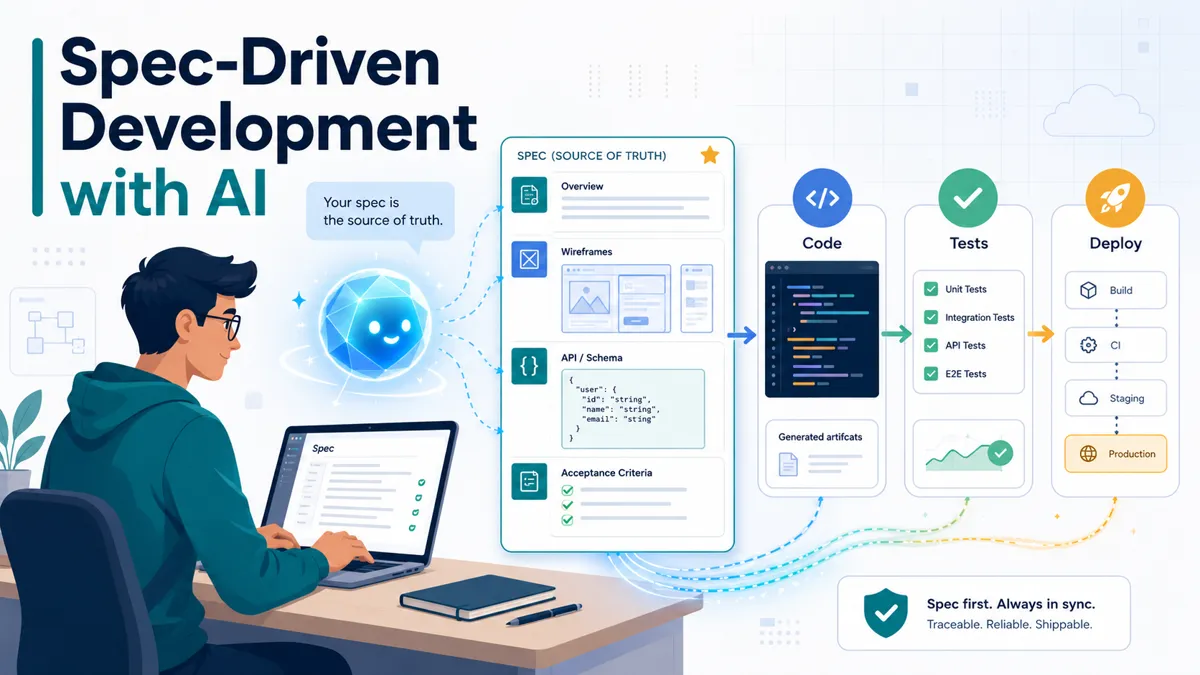
Spec-driven development: bạn viết spec document có cấu trúc (Mục tiêu / User stories / Tiêu chí chấp nhận / Edge cases) → AI đọc spec → AI gen code khớp spec → test tự động verify theo từng acceptance criteria. Đối cực của vibe coding. Ảnh: AI-generated bằng ChatGPT gpt-image-2.
Hiểu đơn giản nhất
Bạn xây nhà. Cách SAI: gọi thợ đến, nói "xây cho tôi cái nhà đẹp" → 3 tháng sau nhà xong không đúng ý → đập đi xây lại. Cách ĐÚNG: vẽ bản thiết kế (blueprint) — chiều dài, số phòng, vị trí cửa, vật liệu — gửi thợ → thợ xây đúng → nghiệm thu theo blueprint.
Spec-driven dev y hệt vậy. Bạn viết spec (bản thiết kế phần mềm) cho 1 feature → AI đọc spec → gen code khớp spec → test tự động verify theo từng tiêu chí trong spec. Mất 30-60 phút viết spec, nhưng tiết kiệm 5-10 vòng "AI gen sai → bạn prompt lại" như vibe coding.
Spec-driven dev là gì? Định nghĩa chính xác
Spec-driven development (SDD — phát triển dựa trên đặc tả) = phương pháp viết tài liệu spec (specification — đặc tả) ngắn cho từng feature TRƯỚC khi code. Spec là input chính cho AI assistant (Claude Code, Cursor) gen code. Test tự động chạy theo acceptance criteria trong spec.
3 thành phần cốt lõi:
- Spec document — file Markdown 15-80 dòng mô tả: Why (mục tiêu), User stories, Acceptance criteria, Edge cases, Out-of-scope
- AI gen code — AI đọc spec, suy luận implementation, gen code
- Verify against spec — test theo từng acceptance criteria, KHÔNG vibe check
Khác với waterfall (1980s): SDD không yêu cầu spec toàn bộ system trước build — chỉ spec từng feature 1, vẫn agile. Khác với vibe coding: SDD có structure, repeatable, verifiable.
Origin: SDD lai giữa Behavior-Driven Development (BDD — Dan North, 2003 — đặc tả hành vi qua Given-When-Then), Domain-Driven Design (DDD — Eric Evans 2003), và AI-native workflows 2024-2026. Tháng 8/2025, GitHub launch Spec Kit (https://github.com/github/spec-kit) chuẩn hoá pattern này cho Claude Code.
Ví dụ thực tế: VietCodex methodology (xem methodology page) áp dụng SDD trong Phase /spec của 6-phase workflow. Trước khi viết 1 dòng code cho client, team viết spec document review với client → client sign-off → AI gen code → test theo spec. Tỷ lệ rewrite giảm từ 30% (vibe-only) xuống 5% (spec-driven).
So sánh Vibe coding vs Spec-driven dev
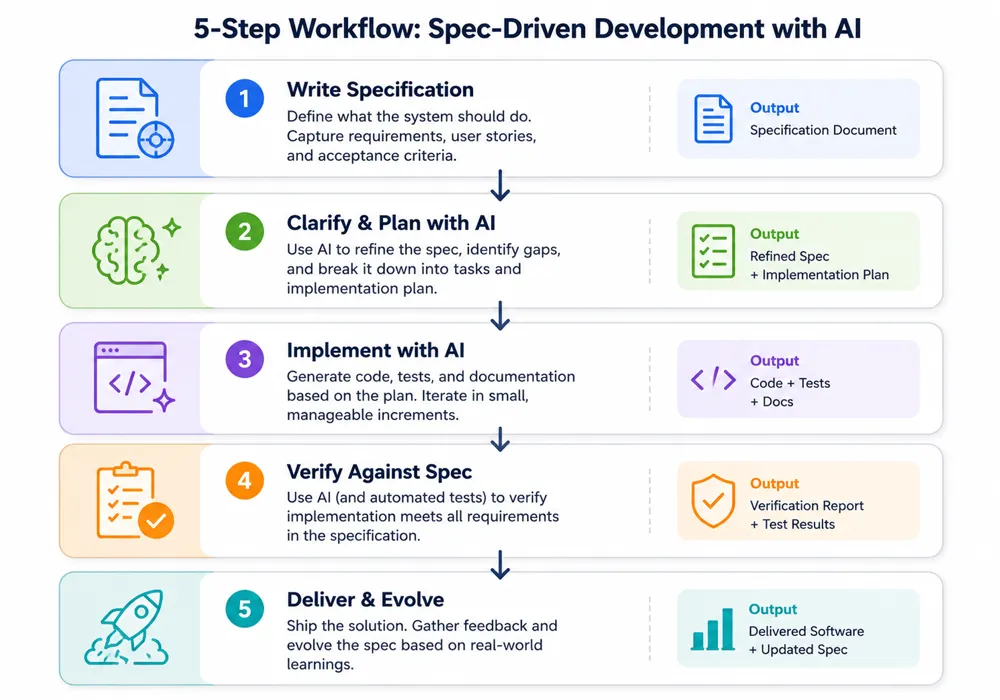
Workflow 5 bước SDD: Viết spec → AI đọc + plan → AI gen code → Test acceptance criteria → Iterate nếu fail. Khác vibe coding (chỉ prompt → output), SDD có gate verification giữa mỗi bước. Ảnh: AI-generated bằng ChatGPT gpt-image-2.
| Tiêu chí | Vibe coding | Spec-driven dev |
|---|---|---|
| Bắt đầu | Prompt tự do | Viết spec document |
| Tốc độ build | Nhanh nhất (1-2 ngày MVP) | Trung bình (3-7 ngày feature) |
| Đọc code AI gen | Không | Có, phần critical |
| Test | Manual sau cùng | Acceptance criteria từ spec |
| Verify | "Vibe ok" | Test pass + spec coverage |
| Code review | Skip | Mandatory, có template |
| Maintenance | Khó (ai cũng không hiểu code) | Dễ (spec là document) |
| Onboard dev mới | 2 tuần | 2 ngày |
| Phù hợp giai đoạn | 0→1 (MVP) | 1→100 (scale) |
| User scale | dưới 50 (MVP) | trên 100 (production) |
| Team size | 1 dev solo | 2+ dev |
| Bảo mật | Rủi ro | An toàn (audit-able) |
| AI tool tốt nhất | Claude Code, Cursor | Claude Code + Spec Kit, Cursor + .specs/ |
Cấu trúc 1 spec hoàn chỉnh — template
Đây là template VietCodex dùng cho mọi feature production. Copy → paste → fill in.
# Feature: User registration

## Mục tiêu (Why)

Cho phép guest visitor (khách chưa đăng ký) tạo tài khoản với email + password
để có thể đặt hàng và xem lịch sử order. Convert visitor → registered user.

## User stories

As a guest visitor đang xem dịch vụ
I want to create an account quickly (≤ 30 giây)
So that I can place order without re-entering info next time.

## Acceptance criteria

AC-1: Form fields
- Given user đang ở /register
- When form load xong
- Then thấy 3 field: email, password, name
- And nút "Đăng ký" disabled cho đến khi đủ 3 field valid

AC-2: Email validation
- Given user nhập email
- When email không match regex `^[^@]+@[^@]+\.[^@]+$`
- Then hiện inline error "Email không hợp lệ" dưới field
- And nút "Đăng ký" disabled

AC-3: Email already exists
- Given user submit form với email đã tồn tại trong DB
- When server check qua API POST /api/auth/check-email
- Then hiện toast error "Email đã có tài khoản"
- And focus về field email
- And user record KHÔNG được tạo

AC-4: Success registration
- Given form valid + email chưa tồn tại
- When user click "Đăng ký"
- Then user record tạo trong DB với password hashed (bcrypt cost 10)
- And session cookie set
- And redirect đến /dashboard
- And email confirmation sent qua SendGrid

AC-5: Password security
- Given user nhập password
- When length < 8 ký tự HOẶC không có ít nhất 1 số
- Then hiện strength indicator: weak/medium/strong
- And block submit nếu weak

## Edge cases

- Network error khi submit → retry với exponential backoff (3 lần)
- DB unique constraint violation (race condition) → return 409, hiện "Email đã có"
- Email service down → vẫn tạo user, queue email send job
- User submit form nhiều lần (double-click) → debounce 1000ms

## Out of scope (Phase 2)

- Social login (Google/Facebook/Zalo)
- Email verification trước khi cho login
- 2FA / MFA
- Password reset flow (sẽ spec riêng)

## Technical constraints

- Stack: Next.js 16 App Router + Drizzle ORM + Postgres
- Auth lib: better-auth (đã setup)
- Validation: zod schema
- Form: react-hook-form
- Test: Playwright E2E cho golden path + Vitest cho validation
6 phần cốt lõi:
- Mục tiêu (Why) — 2-3 câu giải thích lý do feature tồn tại
- User stories — góc nhìn user, format "As a... I want... So that..."
- Acceptance criteria — Given-When-Then cụ thể, đo được
- Edge cases — tình huống bất thường (network, race condition, double-click)
- Out of scope — explicit liệt kê thứ KHÔNG làm phase này
- Technical constraints — stack, lib, pattern bắt buộc
Workflow 5 bước với AI
Bước 1: Viết spec (30-60 phút)
Bạn (founder / PM / dev lead) viết spec qua template. Có thể dùng AI hỗ trợ:
Tôi muốn build feature [TÊN]. Mục tiêu: [WHY].
User: [PERSONA]. Constraints: [STACK].
Viết spec markdown theo template VietCodex.
AI gen spec draft → bạn review, sửa, finalize.
Bước 2: AI đọc spec + lập plan
Trong Claude Code, command:
/plan @specs/user-registration.md
Claude đọc spec, output plan:
Plan:
1. Create lib/auth/register.ts với function registerUser()
2. Add Drizzle schema: ALTER TABLE users (đã có)
3. Create app/api/auth/register/route.ts (POST handler)
4. Create app/(auth)/register/page.tsx với form
5. Add Zod schema validation
6. Add Playwright test specs/registration.spec.ts
7. Update middleware để protect /dashboard
Bạn review plan → confirm hoặc sửa.
Bước 3: AI gen code theo plan
Claude lần lượt implement từng bước, sau mỗi file ask "tiếp tục?". Bạn approve hoặc reject.
Bước 4: Test acceptance criteria
pnpm test specs/registration.spec.tsPlaywright chạy E2E test từng AC. Output:
✓ AC-1: Form fields (245ms)
✓ AC-2: Email validation (180ms)
✗ AC-3: Email already exists (failed: timeout)
✓ AC-4: Success registration (1240ms)
✓ AC-5: Password security (320ms)
Bước 5: Iterate nếu fail
Fail AC-3 → bạn paste log lỗi cho Claude:
AC-3 fail với timeout error. File: app/api/auth/register/route.ts.
Spec yêu cầu return 409 trong dưới 500ms.
Fix.
Claude fix → re-test → pass.
Ví dụ thực tế: Module thanh toán BTB v2 (2025) được build hoàn toàn theo SDD. Spec 75 dòng cho VNPay integration → Claude gen 380 dòng code → 8/8 AC pass lần 2 (lần 1 fail 2 AC, fix trong 20 phút). Tổng thời gian: 4h cho 1 feature critical. Vibe coding ước tính cùng feature: 12h + 3 ngày debug security.
Khi nào dùng SDD / khi nào KHÔNG
✅ Nên dùng SDD
- Production code với >100 user
- Team 2+ dev (cần shared understanding)
- Auth / Payment / Financial code
- Compliance (GDPR, PCI-DSS, HIPAA) — pháp lý yêu cầu audit-able
- API public (other devs depend on contract)
- Database migration không reversible
- Code maintain >1 năm
- Module mission-critical (vd: trừ tiền, gửi email transactional)
❌ Không hợp SDD
- Throwaway script (cron 1 lần) — overhead spec không worth
- Prototype test idea (chưa biết feature có cần không)
- Solo + short timeline (vd: hackathon 48h)
- UI polish thuần CSS/animation (vibe code OK)
- Exploration (chưa rõ requirements)
- Internal tool chỉ founder dùng
Tools 2026 cho SDD
1. GitHub Spec Kit (https://github.com/github/spec-kit) — chuẩn nhất
- Open-source, launch tháng 8/2025
- Template spec markdown chuẩn
- Slash command
/spec,/plan,/build,/verifytrong Claude Code - CI check spec coverage (every PR phải có updated spec)
- Integration với Linear / Jira / Notion
2. Claude Code + custom slash command
- Dùng
.claude/commands/spec.mdđể define custom workflow - Lưu spec trong
specs/folder - VietCodex methodology export tới
.claude/folder
3. Cursor + .specs/ folder
- Cursor đọc tự động mọi
.mdfile trong.specs/ - Drag-drop spec vào Cursor chat → AI dùng làm context
4. Tooling phụ trợ
- Zod — validation schema, AI gen từ spec
- Playwright — E2E test từ Given-When-Then
- Vitest — unit test từng AC
- Linear / GitHub Issues — link spec → ticket
5 cảm bẫy phổ biến khi làm SDD
Bẫy 1: "Spec quá vague" — không đo được
❌ "Hệ thống phải nhanh và an toàn" — không test được ✅ "API response dưới 500ms cho 95% request" + "Password bcrypt cost ≥10"
Mitigation: Mỗi câu trong AC phải trả lời được "tester verify thế nào?". Nếu không → vague.
Bẫy 2: "Spec quá detail" — không có flexibility
❌ Spec 500 dòng định nghĩa mọi class + method name + variable ✅ Spec 50 dòng định nghĩa behavior, AI chọn implementation
Mitigation: Spec WHAT (hành vi user thấy), không spec HOW (code structure). HOW để AI/dev quyết.
Bẫy 3: "Skip spec for small feature"
"Feature này nhỏ, không cần spec" → 2 tuần sau không hiểu code mình viết.
Mitigation: Quy tắc cứng: nếu feature touch auth/payment/data sensitive → spec MANDATORY dù chỉ 5 dòng.
Bẫy 4: "Stale spec" — spec lỗi thời
Code đã update, spec vẫn cũ → spec gây hiểu lầm, dev mới đọc nhầm.
Mitigation: PR template require "spec updated" checkbox. CI check date last-modified của spec vs code.
Bẫy 5: "Spec viết sau code" — chỉ documentation
❌ Code xong, viết spec để document → không có giá trị design ✅ Spec viết TRƯỚC code → AI dùng làm input, force you to think
Mitigation: Process commit-time: spec PR merge trước code PR. PM/lead review spec, không phải code.
Ví dụ thực tế VN — VietCodex 6-phase workflow
VietCodex (xem methodology) áp dụng SDD trong Phase 2 của 6-phase production workflow:
Phase 1: /discover    → Hiểu business + user
Phase 2: /spec        → Viết spec từng feature (SDD)
Phase 3: /build       → AI gen code theo spec
Phase 4: /verify      → Test acceptance criteria + security audit
Phase 5: /ship        → Deploy với monitoring
Phase 6: /support     → Maintain với spec làm document
Real case study: Project SaaS booking salon cho 1 chuỗi 12 chi nhánh (2025). Phase /spec viết 8 spec document cho 8 feature core (auth / booking / staff schedule / payment / notification / report / admin / customer profile). Tổng 4 ngày spec. Phase /build với Claude Code: 12 ngày gen code (1.5 ngày/feature). Phase /verify: 2 ngày fix bug. Phase /ship: 1 ngày. Tổng 19 ngày từ spec đến launch với 0 bug critical sau 6 tháng vận hành.
So sánh: 1 agency truyền thống cùng project ước tính 6-8 tuần. SDD + AI tiết kiệm 3-5 tuần.
Tóm tắt 1 dòng
Spec-driven dev = viết spec markdown 15-80 dòng cho từng feature (Why + User stories + Acceptance criteria + Edge cases + Out-of-scope) TRƯỚC khi code → AI đọc spec → gen code → test theo AC. Đối cực vibe coding. Phù hợp production / team / auth-payment / maintain dài hạn. Tools 2026: GitHub Spec Kit, Claude Code + slash command, Cursor + .specs/. Mix 80/20: vibe cho periphery, SDD cho core.
Đọc tiếp
- Vibe coding là gì? — đối cực, dùng cho prototype/MVP
- Build MVP — MVP xong → SDD cho production
- TDD + Vertical Slicing — combine SDD với test-first (sắp có)
- Multi-agent cost routing — orchestrate agent theo spec (sắp có)
- Claude Code, Cursor, Copilot — tool nào hỗ trợ SDD tốt nhất
- Prompt Engineering — spec chính là prompt structure cao cấp
- 34 khái niệm cơ bản — tra cứu thuật ngữ
Cần build SaaS / web app / mobile app production-ready với SDD + AI Coding? VietCodex áp dụng 6-phase workflow (Discover → Spec → Build → Verify → Ship → Support) tiết kiệm 3-5 tuần so với agency truyền thống. Xem methodology hoặc đặt audit FREE 30 phút.